



When DeepRails set out to build Paige, the standard it had to clear was already forty years old. In 1984, the educational psychologist Benjamin Bloom published what he called “The 2 Sigma Problem” — the finding that a child tutored one-to-one, advanced only on demonstrated mastery, performs about two standard deviations better than a child in an ordinary classroom. Put plainly: the average tutored student outscored 98% of the conventionally taught — and roughly nine in ten reached a level only the top fifth ever touched. The result was never in doubt. The catch was that it took one tutor per child — and no school system on Earth could afford that. For four decades, the best thing we know about how children learn sat on a shelf, too expensive to deliver.
Paige was built to take that result off the shelf — and to do the one thing Bloom's era never had to reckon with: make a tutor safe enough to leave alone with a child. Every Paige lesson is a guided mastery arc, not a worksheet — vocabulary front-loaded, each concept taught, modeled, and practiced, with advancement gated at a hard 80% mastery threshold across 1,313 lessons in Math and ELA, grades 3–8. Every passage is written to the child's exact reading level on the Lexile scale — roughly 720L in grade 3 climbing to 1,120L by grade 8 — so the text is never watered down and never over a child's head. And every single word the tutor says is run through DeepRails Defend before it reaches the screen — validated, and rewritten if need be, so nothing inaccurate or inappropriate ever reaches a child. Not sampled. Not spot-checked. Every interaction. This is the story of how DeepRails built the AI tutor a parent can actually trust.
- Children advance only on demonstrated mastery — gated at a hard 80% threshold, never on seat time
- Every concept runs a full teaching cycle: teach, worked example, guided practice, independent check
- Missed a concept? Routed to targeted extra practice on that exact concept, then a retake
- Unlimited retakes with tiered trophies — Gold, Silver, Bronze, Iron — so persistence is celebrated, never penalized
- Grounded in the validated pillars of how reading actually develops
- Word-level read-aloud highlights each word in sync as the tutor speaks
- A dedicated narrator voice reads ELA passages — a clean teacher-plus-read-aloud division
- Genuine follow-along support for emerging and developing readers
- Content written to the exact grade reading level, ~720L (grade 3) to ~1,120L (grade 8)
- The Lexile target governs all on-screen text — definitions, questions, and feedback, not just speech
- Machine-screened for readability so a child is never over-their-head or under-challenged
- 1,313 source lessons across Math and ELA, grades 3–8, all calibrated to grade level
- Every tutor reply is checked by DeepRails Defend before a single word reaches the child
- Enforced on 100% of interactions — validated and, if needed, rewritten in real time, never sampled
- Math visuals are answer-hiding by design: an unknown renders a literal “?”, never a fabricated number
- Certified Hallucination-Safe™ — the guardrail Bloom's era never had
The Foundation: Half a Century of Learning Science, Engineered Into One Tutor
learning science
could never scale
The 2 Sigma Problem
Benjamin S. Bloom — the result education revered but could never afford to deliver
The intellectual bedrock of Paige. Four decades ago, educational psychologist Benjamin Bloom documented something the field has never forgotten — and never managed to deliver. A student tutored one-to-one, using mastery learning, performed about two standard deviations better than a student in an ordinary classroom: the average tutored child outscored roughly 98% of conventionally taught peers, and about 90% reached the level only the top 20% otherwise hit. It was never an efficacy problem. It was a cost problem — one tutor per child does not scale, and so the best result in education sat on a shelf for forty years. Paige is built to take it down: the 1:1 mastery experience, delivered to every child at once — with the one guardrail Bloom's era never had, safety.
Paige doesn't tutor on instinct — it tutors on a scientific spine the field has studied for half a century. Every lesson is a guided mastery arc, not a quiz: each concept moves through its own teaching cycle — the tutor teaches it, models a worked example aloud, coaches the child through guided practice, then checks for independent understanding — before any concept reaches the cumulative Mastery Test. A child advances only on demonstrated mastery, gated at a hard 80% threshold, never on time served. Below the bar there is no failing grade — only the exact target to clear, targeted extra practice on the specific concept missed, and unlimited retakes that celebrate persistence rather than punish it.
Every word a child reads is held to the right level. Paige's content is Lexile-differentiated to the exact grade, climbing from roughly 720L in grade 3 to 1,120L in grade 8 — and that target governs not just the tutor's speech but every definition, question, and piece of feedback on the screen, machine-screened for readability. Built on the validated pillars of the Science of Reading, with word-level read-aloud that lights up each word as it's spoken, Paige carries the same decades-of-evidence credibility a serious educator demands — engineered for how children actually learn, with safety as the layer that is never optional.
The Challenge: The Highest-Stakes Audience in Applied AI — Children
Most education software optimizes for the easy thing to measure — minutes logged, streaks kept, levels cleared. Paige set out to do the hard thing instead: deliver the experience learning science has revered for forty years — one-on-one, mastery-based tutoring — to a child sitting alone with a screen. Not a worksheet dressed up as an app. A tutor that teaches a concept, watches a child work, diagnoses exactly what they missed, and stays with them until they truly have it — gated at a real 80% mastery bar, never at mere completion.
That ambition runs straight into the single hardest constraint in all of applied AI: the learner is a child, and the tolerance for error is zero. Grading a multiple-choice answer is binary. But producing live tutoring that is simultaneously factually correct, age-appropriate, and pitched to the exact grade reading level — turn after turn, for an eight-year-old who will believe what the tutor tells them — is subtle, contextual, and unforgiving. A confident wrong answer doesn't log as a bug. It teaches a child something false.
And it isn't one judgment that has to be right — it's three at once, on every interaction. The tutor's words have to be accurate and safe. The math visuals have to be exact — a picture can never quietly mislead a child about an answer or hand it away before they've earned it. And the reading level has to land precisely — text written too far above a child's grade defeats them, and text written too far below leaves them under-challenged. Each surface has to clear its own bar, and all three have to clear it together, in real time, every single time.
This is among the hardest things in applied AI to get right — not because of any one feature, but because “good enough” is not a standard you can apply to a child. Get the tutor's words wrong and you misinform. Get the visual wrong and you confuse. Get the reading level wrong and you either discourage or coast. So the bar was absolute from the start: every word a child reads — across 1,313 lessons spanning Math and ELA, grades 3 through 8 — had to be accurate, safe, grade-perfect, and Lexile-calibrated to the exact level, with no tolerance for hallucination and no human standing between the model and the child to catch it after the fact. The only acceptable outcome was an AI tutor a parent could trust alone with their kid.
The Platform: Meet Paige
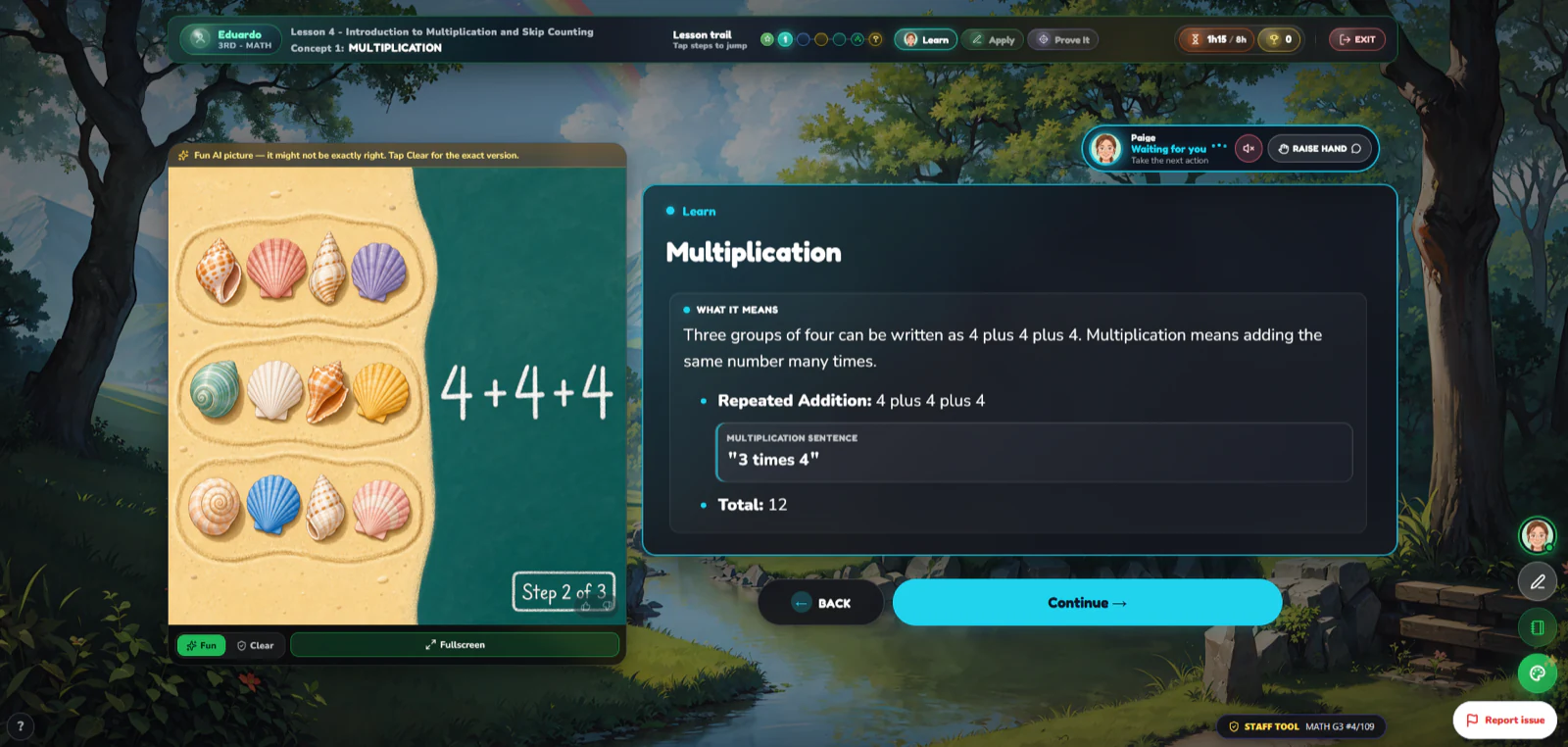
The result is Paige — a one-on-one AI tutor built for children in grades three through eight, where AI is not a feature bolted onto a worksheet but the very medium the lesson runs on. Every child learns inside an immersive classroom — a forest glade, a coral reef, the deck of a starship — and is taught by a voiced tutor they choose: warm, encouraging Paige; calm, curious Carter; or Whisper the pup, with a dedicated Narrator reading every passage aloud, each word lighting up in sync as it's spoken. Every lesson is a guided mastery arc — learn, practice, prove it — gated at a hard 80% threshold before a child moves on. And every word is held to the child's exact grade reading level — Lexile-perfect — while every math illustration is drawn to be exactly right, hiding the answer behind a literal “?” instead of ever risking a number that misleads.
How DeepRails Built It: Safety-First, Verified Before a Child Ever Reads It
The hard part was never teaching a model to tutor. It was making every word a child reads genuinely trustworthy — the first time, every time, with no adult standing between the AI and the kid. DeepRails brought the same evaluation-first, guardrails-first discipline that defines our products: every tutor reply is validated for accuracy, safety, and age-appropriateness before a single word reaches the screen, and every answer a child must find is grounded in real, standards-aligned curriculum — never improvised.
That meant solving five distinct problems at once:
- A real-time guardrail on every reply: Every tutor response runs through DeepRails Defend before it is ever shown — validated, and rewritten in the moment if needed, so the child only ever sees the cleared version. The check runs on every reply, never a sample.
- Grounded in real curriculum, not improvisation: The tutor teaches from 1,313 Lexile-calibrated lessons across Math and ELA, grades 3 to 8 — built on real publisher curriculum and held to the exact reading level of the child's grade. Storybook fabrication is banned outright; problem context must be a verifiable, single-sentence fact, so the tutor never invents people, places, or “facts” a child could absorb as true.
- Math-accurate visuals that can't lie: Every illustration is generated from validated math — the arithmetic has to close, with exactly one unknown — and when an image depicts the very thing the child must solve, it renders a literal “?”, never the computed answer. A picture is structurally barred from leaking, or fabricating, the result.
- Mastery measured by evidence, not vibes: Progress is gated at a hard 80% mastery threshold, and the final test demands transfer — applying a concept in a brand-new context, not reciting a definition. A child advances because they demonstrably understand, and every wrong answer triggers targeted re-teaching rather than a bare “incorrect.”
- Certified, auditable, and child-protective by design: Every lesson clears a quality pass for factual accuracy, internal consistency, and freedom from hallucination before it reaches a child, and the safety layer is shown in plain sight — the “Hallucination-Safe AI · Powered by DeepRails” shield on the login itself. Child identity is protected and accounts are parent-controlled, and dominance- or appearance-based language is stripped, so the only thing Paige ever praises is effort and strategy.
Every word a child reads is cleared by DeepRails first
Paige doesn't simply use AI cautiously around children — it carries DeepRails' Hallucination Safe™ certification, the same discipline that makes accuracy the product rather than an afterthought. Every tutor reply is validated by DeepRails Defend the instant it's generated — and rewritten in real time if anything is off — so the only version a child ever sees is the one that already cleared the bar. It runs on every single interaction, not a sampled few, because the audience is the highest-stakes one in education — and a child should never be the one to discover the model was wrong.
What Makes Paige Different: An Industry Optimizing for Time-on-Screen, Not Mastery
Before a single lesson was written, DeepRails studied the field a parent actually chooses from — the learning apps, the AI-tutor startups, the “now with AI” incumbents, and the tutoring marketplaces. The category is crowded and, in places, genuinely good. But the products cluster into a handful of archetypes — the all-in-one learning platform, the AI-tutoring app, the “AI feature” bolted onto legacy edtech, and the human-tutor marketplace — and almost every one is built to maximize the wrong thing: minutes, streaks, and engagement — not whether a child can actually do the math tomorrow.
The more revealing finding was what none of them would put their name on: an AI that talks to a child unsupervised. The apps that do use AI leave it unguarded — a general-purpose model free to hallucinate a wrong answer, drift off-grade, or say something no parent would allow. The ones that are safe aren't really tutors — they're static lessons and quizzes. And the only thing that has ever reliably worked — a patient human tutor, one-on-one — has never been something most families could afford or scale. That is the exact gap Paige was built to close: a 1:1 AI tutor that is guarded on every reply a child receives.
Bloom's “2 Sigma” research showed that one-to-one, mastery-based tutoring moves the average student to roughly the 98th percentile. It was never an efficacy problem — it was a cost problem: one tutor per child does not scale. Paige delivers that 1:1 mastery experience at scale — and adds the guardrail Bloom's era couldn't: every word verified safe before a child reads it.
An AI that talks is now table stakes — even the legacy apps have bolted one on. So Paige was built to win on what none of them dares to ship: a tutor a parent can trust unsupervised. Every reply is checked by DeepRails Defend in real time — validated, and rewritten if needed — so the child only ever sees the cleared version.
From there, Paige consolidates what the rest of the field splits apart — the reading-level precision of the best literacy tools (every word held to an exact per-grade Lexile target, ~720L through ~1,120L), the mastery discipline of real classroom pedagogy (an 80% gate, no advancing on seat time), and the warmth of a voiced 1:1 tutor with word-synced read-aloud — and then adds the one thing none of them have: math visuals that are proven accurate and physically cannot give away or fabricate an answer. The unknown a child must find is always rendered as a literal “?” — never the number.
| Capability | Paige by DeepRails | Practice & content IXL · Khan Academy | AI tutor apps Khanmigo · Synthesis | “AI feature” edtech Duolingo · Quizlet · Chegg | Tutoring marketplaces Wyzant · Varsity Tutors |
|---|---|---|---|---|---|
| Real-time AI safety guardrail on every single reply | – | – | – | ||
| Reading-level precision, written to an exact Lexile target | – | – | |||
| Voiced 1:1 tutoring with word-synced read-aloud | – | – | |||
| Math-accurate visuals that never leak or fabricate the answer | – | – | – | – | |
| Mastery-gated progress — advance on proof, not seat time | – | ||||
| Built for children specifically, not adults scaled down |
The Outcome: One-on-One Mastery Learning, Finally Within Every Child's Reach
Paige doesn't just digitize a worksheet — it delivers the one thing learning science has known works for forty years and never managed to scale: a patient, one-on-one tutor that won't move on until a child has truly understood. Where other apps reward minutes, Paige rewards mastery. Where others entertain, Paige teaches. Where a single human tutor can sit with one child at a time, Paige sits with every child at once — and where most AI is left to improvise, every word Paige speaks is verified before it reaches a young reader. In the months since launch, that one-on-one experience has reached more than 15,000 active learners — Bloom's 2-sigma result, finally delivered at scale.
- From seat time to real mastery: a child advances only after clearing a hard 80% bar on a transfer-based Mastery Test — proving they can apply a concept in a new context, not just recall it — so progress reflects genuine understanding, never the clock.
- From one-size-fits-all to reading-level precision: every passage, definition, question, and hint is held to the child's exact grade reading level on the Lexile scale — roughly 720L in grade 3 rising to 1,120L by grade 8 — so no child is ever bored by text that's too easy or lost in text that's too hard.
- From a single tutor's reach to every child at once: across 1,313 lessons in Math and ELA for grades 3 through 8, the same guided, four-beat mastery arc — learn, apply, prove it, master — reaches every learner with the attentiveness of a private tutor and none of the cost that kept that promise out of reach.
- From “wrong” to coached: a missed answer is never a dead end — Paige diagnoses the specific misconception, reteaches it, routes the child to targeted extra practice, and welcomes unlimited retakes, rewarding persistence with a trophy on the attempt they finally pass.
- From unsupervised AI to verified safety: every tutor response is cleared by DeepRails Defend on every reply, so a parent can trust Paige unsupervised and know that nothing inaccurate or inappropriate ever gets through.
Why It Had to Be DeepRails
Building a tutor that talks to children is the kind of project most AI companies should not take on — because the cost of being wrong isn't a bad review, it's a child taught something false or shown something they shouldn't see. Paige was built by DeepRails for one reason: we are the only AI company whose core product is accuracy itself. Not a setting, not a safety mode bolted on at the end — the entire thing. When the audience is an eight-year-old, “usually right” is not a standard. It's the only standard there is.
- Evaluation-first by default: we don't ship AI we can't verify — every tutor turn passes through DeepRails Defend before it reaches a child, so reliability is the starting point, not a patch applied after launch.
- Built for the highest-stakes audience there is: our guardrails and evaluation discipline are designed precisely for the cases where being wrong is unacceptable — and there is no higher-stakes user than a child learning to read.
- Grounded in real learning science, not a model's guesses: Paige is built on Bloom's mastery learning, the Science of Reading, and Lexile-precise leveling — encoded faithfully into the product, so what a child learns reflects decades of evidence rather than whatever a general-purpose model improvises.
- Certified, auditable, and trustworthy by design: every interaction carries Hallucination Safe™ certification, math visuals are engineered so a picture can never leak or fabricate an answer, and safety is something parents can see — a visible shield, not a buried promise.
Most companies bolt safety onto an AI product after it's already built. For children, DeepRails built Paige the other way around — a tutor where safety is the product itself — and proved that an AI can be grade-perfect, reading-level precise, and trustworthy enough to leave alone with a child.